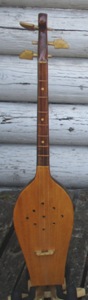
Georgian Panduri. $75.
I’ve been intrigued by the panduri ever since I traveled to the Republic of
Georgia in 2006 and heard one of them being played by a blind busker in a subway
station in Tbilisi. A three-stringed lute with a bowl-shaped back and typical
shovel-shaped profile, the panduri is one of Georgia’s most popular folk
instruments and is often heard accompanying the country’s distinctive style of
polyphonic singing. Like the Russian balalaika, it’s typically tuned DAD,
although it usually has nylon strings and is strummed with the fingers rather
than a pick. It’s more often heard in chordal playing rather than melody,
although accomplished players can get a variety of tones and complex rhythms out
of the instrument by varying their right-hand attack.
Of course I hoped to buy a panduri before I left Georgia, but not speaking the language or knowing what the instrument was called, I had no success in tracking one down. I acquired this one here in the States.
Please keep in mind: I think this panduri was made for the tourist trade and is intended more as a wall hanger than a functional instrument. It will make a pleasant sound when strummed with open strings, but lacks a proper fretting system and it would take some work to turn it into a functional instrument. Either that or it corresponds to some tuning/fretting system I don’t understand, and if you can figure it out you’re a better musician than I am.
It doesn’t have a fretboard as such—the wooden frets are laid into the top surface of the neck. Making it functional would entail removing the frets, planing down the neck, and installing a fretboard with 12 correctly spaced chromatic frets—certainly not beyond the skills of a competent luthier, but a process that’ll cost you more than I’m asking for the instrument. Barring that, a panduri certainly looks nice on the wall and makes for a great conversation piece.
It has only 7 frets, whose placement seems more or less arbitrary. I thought perhaps it was supposed to have a diatonic or pentatonic system, rather than a chromatic one, but the intervals these frets produce are unfamiliar. It’s 29.5 inches long; it appears to have a spruce top. The back seems to be carved from a single piece of hardwood, possibly oak although that’s just a guess, and has a dark finish. The action is nice and low with the current bridge placement; again the 3 strings attach to a wooden endpin. It’s plain in appearance, with no decorations apart from fret marker dots. See more photos, call 425/772-0231, or for more information. $75 plus shipping.
If you want to hear what a properly intonated and well-played panduri sounds like, here’s the wildly popular Trio Mandili (with a donkey!) to demonstrate:
Of course I hoped to buy a panduri before I left Georgia, but not speaking the language or knowing what the instrument was called, I had no success in tracking one down. I acquired this one here in the States.
Please keep in mind: I think this panduri was made for the tourist trade and is intended more as a wall hanger than a functional instrument. It will make a pleasant sound when strummed with open strings, but lacks a proper fretting system and it would take some work to turn it into a functional instrument. Either that or it corresponds to some tuning/fretting system I don’t understand, and if you can figure it out you’re a better musician than I am.
It doesn’t have a fretboard as such—the wooden frets are laid into the top surface of the neck. Making it functional would entail removing the frets, planing down the neck, and installing a fretboard with 12 correctly spaced chromatic frets—certainly not beyond the skills of a competent luthier, but a process that’ll cost you more than I’m asking for the instrument. Barring that, a panduri certainly looks nice on the wall and makes for a great conversation piece.
It has only 7 frets, whose placement seems more or less arbitrary. I thought perhaps it was supposed to have a diatonic or pentatonic system, rather than a chromatic one, but the intervals these frets produce are unfamiliar. It’s 29.5 inches long; it appears to have a spruce top. The back seems to be carved from a single piece of hardwood, possibly oak although that’s just a guess, and has a dark finish. The action is nice and low with the current bridge placement; again the 3 strings attach to a wooden endpin. It’s plain in appearance, with no decorations apart from fret marker dots. See more photos, call 425/772-0231, or for more information. $75 plus shipping.
If you want to hear what a properly intonated and well-played panduri sounds like, here’s the wildly popular Trio Mandili (with a donkey!) to demonstrate: